Webster's 1828 Dictionary
The definitions the Founders knew
Noah Webster's American Dictionary of the English Language of 1828 defines words the way the generation closest to the King James still used them — often with Scripture as the example. Search both volumes by word, browse by letter, or wildcard a beginning: CR* lists every entry that starts with those letters. Each entry also carries its numbers: its word number, its headword number in the printed book, and its spelling as numbers.
Where to find it
- Strong's Dictionary
- Webster's Search
- Downloads
Sidebar → Library → Webster's Search


Webster's 1828 Dictionary
Search both volumes by word, wildcard, or letter.
Webster's Search
An American Dictionary of the English Language 1828
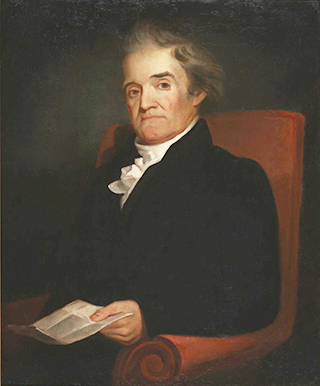
Noah Webster (1758–1843) spent twenty-eight years writing what would become the most ambitious dictionary in American history. When An American Dictionary of the English Language was published in 1828 he was seventy years old, and had taught himself twenty-six languages so that he could trace words to their earliest roots. He believed language inseparable from moral and spiritual truth, and he drew on Scripture throughout his definitions.
Read again from the printed page
The dictionary on this page is new. It was not copied from the text that circulates online; it was read directly from facsimile images of the 1828 printing — both volumes, 1,832 pages, more than 414,000 printed lines — and then processed, cataloged line by line, and compared against the public-domain versions found everywhere else. Every line on this site can be traced to the place on the page where Webster's printer set it.
That reading restores what the circulating text leaves out. Webster's etymologies are here in full, with their Greek, Hebrew, Arabic, Syriac and Ethiopic set in their own letters. His authorities — Dryden, Milton, Shakspeare, Locke, the Encyclopedia — stand where he cited them, on more than fifty thousand definitions, with the quotations he chose. His marks of pronunciation are kept on every headword. And the Additions and Corrections he printed at the end of the second volume are attached to the articles they amend.
Nothing has been silently improved. Where the printer misspelled a word, it is misspelled here, exactly as printed, with a note of the word that was meant — so polluted still finds the article the printer headed PLLLU'TED. Where uneven inking left a period or a hyphen too faint to see, that is noted as well. The aim is the book as it was printed, with every correction visible rather than buried.
The 61,199 index
For years the rest of this site has counted by an older index: the list of 61,199 entries drawn from the public-domain text in common circulation. That list is imperfect. It carries keying errors, it splits some words and joins others, and it passes over thousands of Webster's headwords altogether. It has nevertheless been left exactly as it was received, because its word numbers have proved strangely beautiful in the way they align with Scripture — and an index that is corrected is an index whose numbers move. Some wrinkles, it turns out, could not have been more perfectly placed. Every word number on this site still means what it has always meant.
The new work does not replace that index; it fills in what the index left behind. All 61,199 entries have been matched to the printed articles they point at. Where the old list misspelled a headword, the printed spelling is shown and the old one still finds it. Headwords the old list never had — nearly three thousand of them, along with the second and third headwords Webster often set over a single article — can now be searched and read, marked plainly as having no word number. A search brings every article printed under that spelling: wind the noun and wind the two verbs arrive together, as one entry point.
For those who want it, each entry also records where it stands in the printed book itself — its place among the headwords and articles in order of appearance, and the page of the 1828 printing it was read from. Those figures are offered as information only. The numbers this site counts by remain the 61,199.
What you can do here
Both volumes
A–L and M–Z, searched together.
Faithful to the page
Webster's own marks for pronunciation are kept, letter for letter.
Browse and wildcard
Step to the entries before and after, or list a whole beginning.
Every word numbered
Word position, printed headword number, and numeric and phone-keypad spellings.
Try these in the Webster's search box
Type any of them into the Webster's search box once you are signed in.
SCRIPTURE
A writing — and, by way of distinction, the Bible.CHARITY
Love, benevolence, good will — citing 1 Corinthians 13.GRACE
Favor; the free unmerited love and favor of God.MARRIAGE
"Instituted by God himself" — with Hebrews 13 and Matthew 22.WIND
The noun and both verbs, as printed, together.CAT
"A deceitful animal, and when enraged, extremely spiteful."CR*
Every entry beginning with CR — CRAB and CRACK open in the tour.Like what you see? Create a free account and every tool is yours.